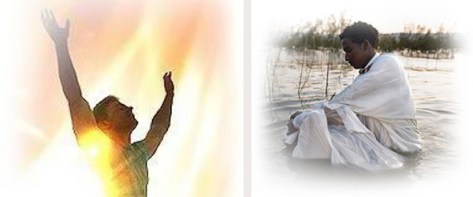
Fr. Raniero Cantalamessa is the papal preacher to Pope John II’s pontifical household. He is a Charismatic Catholic, or a Spirit-filled Catholic, if you choose to call him that. In his book Sober Intoxication of the Spirit, he gives a good insight on the sacrament of water baptism and how that relates to the baptism in the Spirit.
First of all, the baptism in the Spirit, or the spiritual outpouring, is not a sacrament; it cannot be a sacrament because it is purely a spiritual reality. However, it actualizes or renews the “unreleased” sacrament.
“A sacrament is called ‘unreleased’ if its fruit remains bound, or unused, because of the absence of certain conditions that further its efficacy.”[1]
What are the conditions of the sacrament? To answer that we have to ask, what is the sacrament? Fr. Cantalamessa states that a sacrament has two components: (1) the divine grace and the will of Christ and (2) the free-will of the human. When a sacrament is validly administered to an individual, the work of God’s grace is present and actual in the sacrament; however, if the individual does not confirm the sacrament by personal faith, the sacrament remains “unreleased.”
According to Fr. Cantalamessa, “baptism is like a divine seal stamped on the faith of man.”[2] Interestingly, he sees a problem with infant baptism: although the sacrament of baptism that is administered to the infant is valid, the infant cannot respond with faith; thus, the baptism remains “unreleased” in the further life of the infant.
How does the outpouring of the Holy Spirit relate to this? First of all, let’s take into account the following comment of the papal preacher concerning the early church:
“Now we can understand why baptism was such a powerful and grace-filled event in the early days of the Church and why there was not normally any need for a new outpouring of the Spirit like the one we are experiencing today. Baptism was administered to adults who were converting from paganism and who, after suitable instruction, were in a position to make an act of faith, and existential, free and mature choice about their lives.”[3]
The Charismatic renewal is God’s gracious second chance. It happens when a person, through repentance, makes a decision of faith.
“For the adult who has been a Christian for many years, this faith decision necessarily has the characteristic of a conversion. We could describe this outpouring of the Spirit, insofar as the person is concerned, either as a renewal of baptism or as a second conversation.”[4]
The final two points from Fr. Cantalamessa: (1) the baptism in the Spirit is not the only means to the renewal of the sacraments of initiation; (2) Jesus Christ fills the believers with the Spirit not only in the sacrament of baptism, but also in the other “means of grace”; the outpouring of the Spirit is linked not only to initiation, but also to perfection of Christian life.
It is the second point that explains the presence of the Holy Spirit among the Pentecostals, who do not have a concept of sacraments of initiation or a high view of water baptism. This also says that the outpouring of the Holy Spirit, according to Fr. Cantalamessa, is “a promise and an instrument of unity among Christians.”[5]
[1]Raniero Cantalamessa, Sober Intoxication of the Spirit (Cincinnati, OH: St. Anthony Messenger Press, 2005), 42.
[2]Ibid, 44.
[3]Ibid, 45.
[4]Ibid, 48.
[5]Ibid. 53.
 Journey to Theosis