Table of Contents: “Back to the Sources” series:
• Part 1: On Inevitability of the Sacraments
• Part 2: On Inevitability of the Creeds and the Symbols (coming soon)
• Part 3: On Inevitability of the Liturgical Prayer (coming soon)
______________________________________________________________________
There can be no religious society, whether the religion be true or false, without some sacrament or visible symbol to serve as a bond of union. The importance of these sacraments cannot be overstated, and only scoffers will treat them lightly. For if piety requires them, it must be impiety to neglect them. -St. Augustine[1]
The word “sacraments” is best defined by the Augustinian formula “visible signs of invisible grace.” In the Christian religion, the primary two sacraments are the Eucharist (the Lord’s Supper) and the rite of baptism, though there are other sacraments and sacramental realities. Historically, the Church has always understood that sacraments are the primary means of grace, that grace is mediated by these visible signs.
Unfortunately, in recent centuries and decades, there was a drift away from the observance of the sacraments in some major Christian evangelical groups. These groups are very passionate about other good things, such as prayer, preaching of the Word and evangelism, but they underestimate the power and meaning of the sacraments; possibly due to ignorance or lack of knowledge.
However, as Augustine said, “there can be no religion without some sacrament or visible symbol.” Similarly, a careful look at these Christian groups reveals that they, practically, perceive some things to be sacramental, although they may not be talking about them in these terms. This proves that sacraments are inevitable, and rejection of one sacrament just leads to emergence of another. Let’s take a closer look how this played out in relation to the two primary Christian sacraments.
Baptism. Historically, Christians have understood the sacrament of baptism to signify, in a very real sense, their death to sin and their resurrection with Christ, in Christ, and for Christ. Any Christian in the first eighteen centuries of the Church history, if asked when he/she became a Christian, would probably give a date of his/her baptism, when he/she pledged a good conscience towards God (1 Pet 3:21).
In those churches where baptism is undervalued, something else will arise to fill its place; the most popular modern “sacrament” that came as a replacement of baptism is the conversion experience. Modern evangelicals, when asked when they became Christians, give the date of their conversion. Some preachers went as far as to say that if you do not remember the time and place of your conversion, you may not be a true Christian yet, and you may still be in need of conversion.
This creates a problem: it universalizes the conversion experience, makes it necessary for everyone, and thus puts a limit on the Holy Spirit in how He draws people to the path of salvation. The Bible and the Christian religion do not require everyone to have the same conversion: some become Christians because of the childhood Sunday school education; some grow in Christian families and never really cease to be Christians; some have a dramatic rescue from bondage of drugs, alcohol, or what not; some have a calm and long intellectual reflection on higher things; and there are many other ways people came to find out about Christianity. And the Spirit works in all of them. Every personal search for Christ is glorious in its own way, and it would be wrong to emphasize one way of conversion over another. The Scriptures do not require Christians to have a conversion experience, but they require a life of humility and continual repentance; they do not required Christians to be unified by one way of conversion, but by one baptism (Eph 4:5).
The different conversion experiences are like paths that lead to one gate; and that gate is baptism. No matter how you heard about Christ and His Church, what matters is that you enter that Church through the gate of baptism, when you leave the old man and become the new man, when you die for you sin and resurrect for Christ.
Thus, we see that baptism is a primary sacrament and all alternatives to it do not measure up in symbolism, meaning, value, and power.
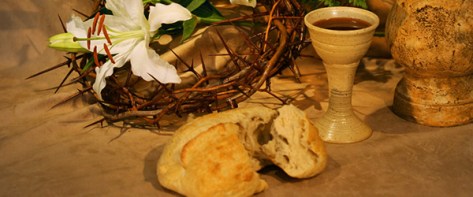
Eucharist or Communion. This rite is central to Christianity, because it is when Christ invites His people to join Him at His table and partake of the bread and cup of the new covenant. Although there were disagreements over the nature and use of this sacrament, Christians have agreed that it must be done. This sacrament is the ultimate proclamation of the Lord’s death until He comes (1 Cor 11:26). It has been held throughout Church history that something is happening when Christians partake in the Eucharist, there is a special power present, a special mediation of grace, a space presence of Christ in the midst His people. The most intimate time between Christ and His Bride happens at the Lord’s Table, in the sacrament of Holy Communion.
Some have reduced the value and meaning of Eucharist to a mere memorial service, or even to lesser degree. Some churches have it only a few times a year and they have no idea why they have it at all. But, when this sacrament is removed, something else arises to fill its place and the most popular alternative is the modern worship.
Many evangelical Christians today think that the most intimate time they can have with Christ is in singing modern worship songs. Many think that worship is the central part of a Sunday morning church service, when traditionally it has been the Lord’s Table. Many think that the most special power and grace is manifested in the time of modern worship; and often worship leaders will open the service with words like “something happens when you praise” but it will not be heard in the same service that something happens when you partake in the Eucharistic meal.
Again, this puts a limit. Worship is a free expression of every Christian. Worship cannot unite, but must be celebrated in diversity. When worshipful singing replaces Eucharist, it puts a limitation on how people can worship, because a certain way of singing is promoted as a primary, and people cannot worshipfully express their personalities. Churches that put worship in the place of the Eucharist (in the center of the service) will usually find more power in the newest upbeat “praise” songs or the mellow “worship” songs than in traditional hymns that are centuries old and stood the test of time. And people who like the hymns must sing the songs that they don’t really like, because that’s the right thing to do, they are told. Same thing happens if the hymns are overemphasized, and there are no new songs written.
Worship must be celebrated in the diversity of personalities that are present in the church community, but the ultimate worship that unites all of the believers is the Holy Communion. After all, the word “eucharist” means thanksgiving. It is in the Eucharist that people experience the ultimate worship, the ultimate grace, the ultimate intimate time with Christ, the ultimate unified celebration of their diverse personalities.
All of this is not to say that evangelism, conversion experiences, or modern worship are necessarily bad. They must be dealt with separately, and I am sure they are very important and there is a place for them, maybe they can even be sacramental in some sense. But one thing is sure, they do not measure up to and cannot replace the primary Sacraments that unified the Church throughout ages and unify all believers today.
[1] Augustine, Reply to Faustus XIX.11. Online. http://www.newadvent.org/fathers/140619.htm. Accessed on May 17, 2010.
 Journey to Theosis