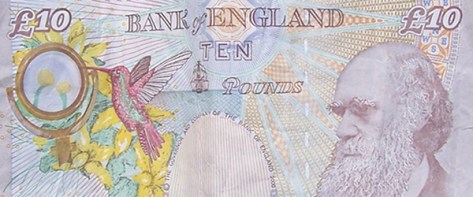
Evolution was not Darwin’s original idea; it existed long before him. Neither did he come up with the phrase ‘survival of the fittest.’ Darwin’s achievement was combining these ideas to provide an explanation for a mechanism that drives human evolution. The idea of survival of the fittest, which Darwin applied to biology, was earlier used by economists, who argued for free trade economy.
Darwin’s biology has been and continues to be controversial, both in science and religion. However, very few (especially among anti-Darwin American conservative Christians) consider the economic origins of his ideas, as well as their economic implications, which were the driving ideology of 19th century imperialism of European superpowers.
A biological mechanism for creation and development of natural life is a secondary issue in Christianity. So is the duration of time that it takes. But the idea of survival of the economically fittest is opposed to the Scriptures, to Christ’s teachings on Kingdom of Heaven and His association with the poor, and to our Christian responsibility to manifest the Kingdom of God that is near. We are not to have strong power over weak, but to have the ‘fittest’ take care of the ‘not so fit.’
Karl Pearson (1857-1936), an English commentator, made this observation of social Darwinism and European imperialism. His thoughts can be applied to some forms of modern capitalism:
You may hope for a time when the sword shall be turned into the ploughshare, when American and German and English traders shall no longer compete in the markets of the world of raw materials, for their food supply, when the white man and the dark shall share the soil between them, and each till it as he lists. But, believe me, when that day comes mankind will no longer progress; there will be nothing to check the fertility of inferior stock; the relentless law of heredity will not be controlled and guided by natural selection. Man will stagnate. . . . The path of progress is strewn with the wreck of nations; traces are everywhere to be seen of the hecatombs of inferior races, and of victims who found not the narrow way to the greater perfection. Yet these dead peoples are, in very truth, the stepping stones on which mankind has arisen to the higher intellectual and deeper emotional life of today.[1]
Dead people are casualties of progress… Maybe this is the kind of Darwinism that we should be opposing at first?
[1]Quoted in Donald Kagan, Steven Ozment and Frank Turner, The Western Heritage: Combined Volume (Upper Saddle River, N.J.: Prentice Hall, 2004), p. 595. Originally taken from Karl Pearson, National Life from the Standpoint of Science, 2nd ed. (Cambridge, UK: Cambridge University Press, 1907), pp. 21, 26-27, 64.
 Journey to Theosis